Haihui Eastern editorial team · Published 2026-10-08 · Reviewed 2026-10-09

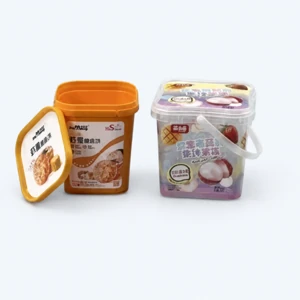
Should you choose a round or square bucket?
Choose the bucket that meets your filling, closure, handling and packing requirements in its confirmed dimensions. Round formats offer a continuous curved decoration surface. Square formats introduce panels and corners that affect label layout and the pack footprint. Shape alone does not establish strength, sealing performance or usable capacity.
Begin with your existing filling line, shelf or transit pack. Record the space available, how a bucket is picked up, where the lid is opened and what the operator needs to see. These observations are more useful than selecting a shape from a photograph alone.
Compare the actual geometry
| Selection question | Round format | Square format |
|---|---|---|
| Artwork surface | Plan reading around a curved body | Plan panels, corners and orientation |
| Footprint | Confirm body and lid diameters | Confirm length, width, corners and lid overhang |
| Filling equipment | Check access and locating arrangement | Check opening geometry and required orientation |
| Handling | Review handle, grip and filled weight | Review handle, grip and orientation |
| Transit packing | Calculate with the actual external dimensions | Calculate with the actual external dimensions |
| Working fill versus brimful volume | Confirm both for the selected round model | Confirm both for the selected square model |
| Lid envelope | Include rim diameter and lid overhang | Include corner shape and lid overhang |
| Handle clearance | Check attachment position and carrying arc | Check panel interference and carrying arc |
| Sample evidence | Trial the complete filled body/lid/handle assembly | Trial the complete filled body/lid/handle assembly |
| Commercial comparison | Match quantity, label designs, packing and delivery terms | Match quantity, label designs, packing and delivery terms |
Choose by operational constraints, then verify a sample
Shortlist a round format when a continuous curved artwork surface and the available circular opening suit your existing process. Shortlist a square format when panel orientation or a defined rectangular external envelope matters. These are starting criteria, not guarantees of strength, stacking performance or lower shipping cost.
If neither option fits the available height, dosing method or opening needs, compare a tub or container format. Use the same contents, working fill, lid requirements and destination when requesting alternatives. Keep artwork and any tooling changes visible in the commercial comparison.
Define capacity before comparing sizes
State the intended fill quantity and its unit. A product sold by mass also needs its density or a filled sample to help establish the required volume. Distinguish your working fill level from brimful volume and allow the headspace your process requires.
Request a dimensioned drawing of the exact model. Include the lid and handle in the external envelope when they affect the carton or filling line. Do not estimate capacity by scaling a catalogue image or comparing photographs taken from different angles.
Review the lid and handling system together
Tell the supplier whether the container is opened once or repeatedly, whether a tamper-evident feature is required and whether contents are poured or scooped. Ask how the proposed lid is fitted and removed. A sample should include the exact closure components rather than a similar-looking alternative.
For handled buckets, specify the filled mass and carrying conditions. For stacked packs, describe storage duration, temperature and load arrangement. Any drop, stacking or sealing requirement must become an agreed test for the selected model; it cannot be inferred from round or square shape.
Check how the label reads in use
Put the principal information where a buyer or operator will see it. A round wrap may require a clear front and back reading sequence. On a square bucket, panel orientation, corners and the position of the handle can influence which information remains visible.
Prepare artwork on the supplier’s confirmed dieline. Check small text, barcode locations and the overlap or seam zone on a proof and, where needed, a physical sample. Do not flatten a photograph into a production label template.
Send a comparison brief that produces useful quotations
- Contents, intended use and target market
- Required fill quantity and external size limits
- Filling method, temperature and line constraints
- Exact lid, seal and handle requirements
- Artwork surfaces and number of designs
- Order quantity, packing method and delivery destination
Use one approval checklist for both candidates
Request identified samples with the matching lid and handle. Record the drawing revision, working fill, line fit, opening method, label orientation and agreed handling trial results. Photograph the same views for each candidate so the comparison can be reviewed later.
A changed lid, resin, handle or label construction may require another review. Keep the chosen pack, artwork proof and purchasing terms in the same approval record. Do not treat a sample photograph as a performance certificate.
Purchasing questions
Does a square bucket always use less shipping space?
No. Compare actual outside dimensions, lid and handle protrusions, nesting, carton allowances, filled mass and pallet restrictions. A rectangular footprint is only one input to the packing plan.
Can I compare buckets using the same advertised litre value?
Only after confirming what the value means for each model. Working fill, nominal volume and brimful volume may differ. Keep the contents, required headspace and measurement basis consistent.
When should I compare a tub instead of a pail?
Consider a tub when opening access, pack height or filling-line constraints are more important than a carrying handle. Confirm the actual dimensions, matching lid and intended-use evidence for that alternative.
Sources and further reading
General purchasing guidance does not replace the approved model drawing, test results or order terms.